Where is the red line between observing a life and appropriating it?

The author, a writer by happenstance, had always thought he would die young. Now older, having failed to fulfill that prophecy, and weighed down by other traumas of life, he has found himself reduced to surviving in the shelter—or cage—of routine.
Thanks to these routines, he gets to know Flor and Tomàs separately. He runs into them in his day-to-day life—at the café, the gym, the park—and they tell him their stories of primal brutality. Flor is a retired chemist who served time in prison for poisoning her husband. Tomàs is a young African former unaccompanied minor who, through prostitution, has managed to escape precarity.
Both of them enrich the author’s daily life, and he listens to them attentively while passing himself off as a harmless, boring early retiree from La Caixa, all the while reflecting on his own vital apathy. Selfishly, he thinks he may be able to steal a good novel from this retired murderess and this young immigrant gigolo.
When, out of a sense of duty, he agrees to stand in for a colleague as the teacher of a writing course at the local community center, the boundaries between living and narrating begin to blur. Everything is turned upside down. The students’ voices, the stories that are shared—almost like Russian dolls—and the proposed exercises open up dangerous ground: what can be told, what should remain unsaid, and what part of another person we unwittingly turn into literary material.

In short, Els búnquers is a metafictional autofiction of ideas that interrogates routine, the passage of time, and the responsibility of telling, with Barcelona/Guinardó as its intimate topography. A narrator who hides behind a discreet identity in order to understand Flor and Tomàs, and who, in the collision with their stories, recovers his voice.

Published by:

«LA PART SALVATGE» synopsis.

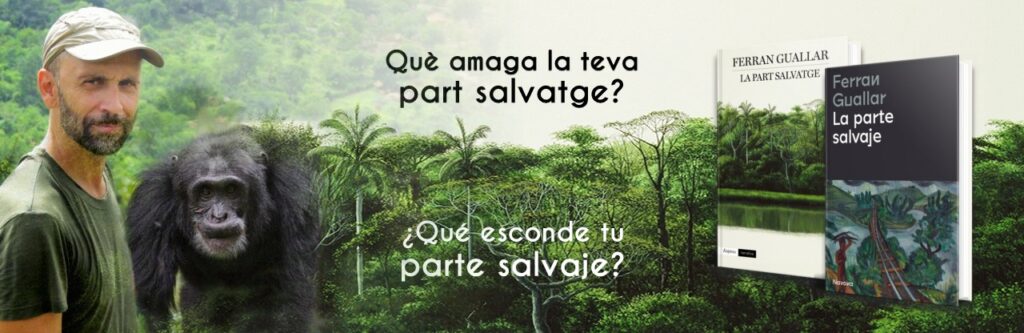
Paul Murray, an anthropologist specializing in evolution and primates, lives his personal decline in a small African paradise for naturalists. After fifteen years, he has overcome a past in which he was haunted by violence and even seems to have found love, or something similar. Day by day, however, his field notes about a chimpanzee who has recently been dethroned as alpha male unwittingly reflect his moment in life, in which he does not see, or does not dare to see, the new circumstances that drown him little by little. A latent threat that can lead to the destruction of everything he has tried to protect: the forest, the chimpanzees and the future of the inhabitants of a paradise where the irrationality underlying humans threatens to become the new normal.

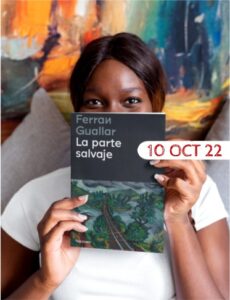
In between the African adventure and the novelistic exploration of the nature of the human being, Ferran Guallar’s «La part salvatge» draws on his years in Africa and, with a vividly suspenseful plot that advances relentlessly, it thrusts us into our less explored side, the one that makes us tremble at the force of nature, fight lost wars, or fall in love with someone we shouldn’t.
Published by

In Catalan
In Spanish
In french

OTHER NOVELS AND TV SERIES

Literary english rights available for the «La part salvatge» (The wild within) and the adapted TV series based on it. Please contact Pontas International Literary and Film Agency.